
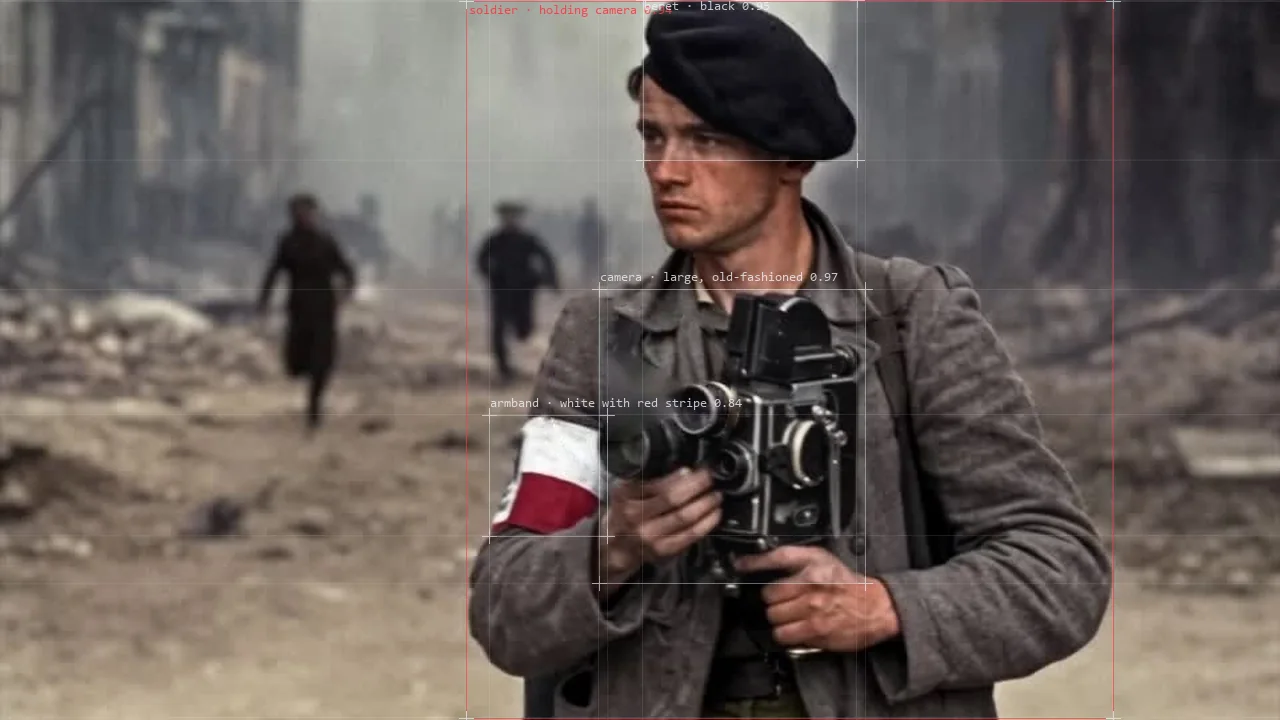
Elegy, one of the Polish films in the final of the Machine Cinema GenJam Director’s Cup, looks so much like archive photographs brought to life that, according to the people who made it, viewers do not spot the AI. “Viewers think it’s made of real photographs set in motion. They don’t spot the AI at all. Meanwhile, exactly one photograph in this entire film is real,” wrote Maciej Żemojcin, one of its authors, after Poland won the tournament.
His post is one of the best inside accounts of how the Polish win was built. Sixteen countries, 510 films, and a format that strips filmmaking to the bone: a finished film of about ninety seconds in four hours. The ARTOS Foundation fielded three Polish teams, and Żemojcin’s Elegy, made with Adam Bajerski, who directed it, Filip Czernow, Michał Siedlecki and Emilian Szopa, was one of them. Another was SIREN, by cinematographer Bartosz Nalazek PSC with Andrzej Świtał, Piotr Dudak and Bartłomiej Oprządek.
“Special thanks for all the organizing and convincing”
In the middle of the thank-yous there is a sentence that explains how many of these people ended up in a tournament at all: “Special thanks to Bartosz Nalazek, PSC and to Michal Jan Owerczuk for all the organizing and convincing to be part of this amazing process.” Owerczuk entered Poland into the Director’s Cup, captained the team and spent much of the tournament helping other Polish crews while making his own films solo. He explained why in a statement published by Interia during the competition:
“I wanted a team that is diverse not only in skills but also in experience and ways of thinking about storytelling. Technology is a tool. What matters most are the people, the collaboration and what we really want to say to the viewer.”
Żemojcin’s post lands on the same idea from the other side. “When AI becomes invisible, the conversation is finally about the film,” he wrote. “Four hours on the clock strip filmmaking down to what decides everything: idea, story, visual choices, editing. A team that plays well together is the force.”
Three Polish films at the top
The post closes with congratulations to three films: “Ursula” by Michał Jan Owerczuk, SIREN, and Elegy. In Żemojcin’s count, the ARTOS teams took second place with SIREN and third with Elegy. The official tournament hub, which publishes the judges’ final ranking, lists URSULA first, The Last Unemployed second and SIREN third, all three from Poland. Either way, the final belonged to Polish films, and the country’s score, the sum of its three best entries, made Poland the first champion of the cup after a 3:0 win over Indonesia.
For Owerczuk that was the point of bringing such different people together. “The Director’s Cup proves that AI does not have to lead to uniform content,” he said in a statement to BRIEF. “It can help creators tell stories that come from their own culture, experience and sensibility.” Elegy, built on the poetry of Krzysztof Kamil Baczyński and the Warsaw Uprising, and URSULA, built on Jan Kochanowski’s Laments, are two very different answers to that sentence.
Original sources: Maciej Żemojcin on LinkedIn, Machine Cinema, Director’s Cup hub, Interia (in Polish).
Source: LinkedIn (opens in a new tab). Facts checked against the source on .