
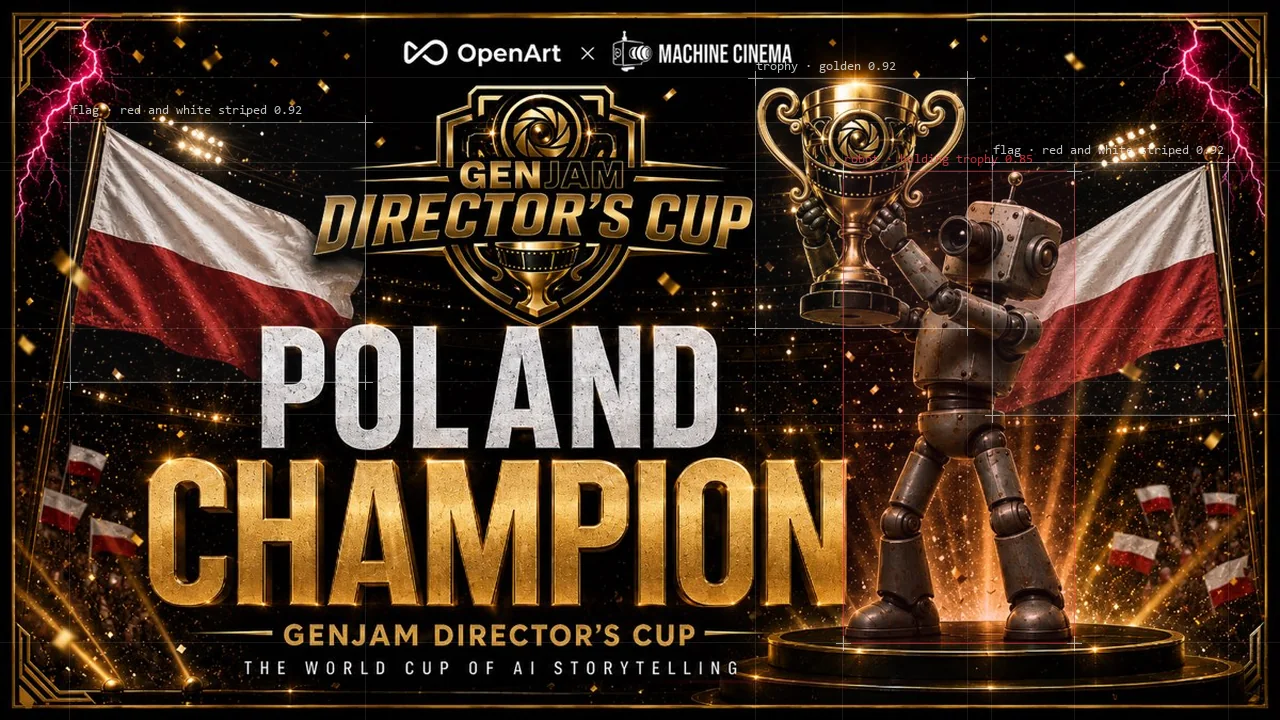
Nobody had won the Machine Cinema GenJam Director’s Cup before this summer, because there had never been one. The first world championship of films made with generative AI started with more than a thousand registered creators from over sixty countries, sent sixteen national teams into a knockout bracket and ended with Poland on top. In the final the Polish team beat Indonesia 3:0, completing a run of four straight wins against teams from Europe, Africa, North America and Asia.
The man who put Poland on the entry list is Michał “OverJK” Owerczuk, director, captain of the team and, by the tournament’s own count, its MVP.
“I entered Poland into this tournament because, after several years of taking part in hackathons and watching the international scene, I knew we had people who could compete with the best. I assumed a Top 3 was within our reach, but only when we beat the USA in the semifinal did we truly believe we could win the first AI video world championship.”
Four rounds, four continents
The bracket did not make it easy. Poland opened with a 3:0 win over France in the round of 16, then beat Nigeria, the team of the Nollywood creators, 2:1 in the quarterfinal. The semifinal against the United States ended 2:1 as well. On the other side Indonesia had knocked out South Korea, India and Great Britain before losing the final 3:0.
The format was built around a clock. In each of the first three rounds teams got a new theme and four hours to deliver a finished film. The final stretched the limit to 24 hours and added a structural rule: every story had to follow Kishōtenketsu, the four-act form of introduction, development, twist and reconciliation. Films were scored by a jury of about thirty people from film, music, media and technology on five criteria, and a country’s score was the sum of its three best films. Across the whole tournament 510 films were made. The prize pool of cash and credits was worth 35,000 US dollars.
A team of people who would never have met
The Polish squad was deliberately mixed. Besides Owerczuk it included Marta Solik, Dominika Aurelia Korycka, Adam Bajerski, Maciej Żemojcin, Emilian Szopa, Michał Siedlecki, Filip Czernow, Monika Jakutowicz, Marta “Mary” Sołtysiak, Laura Tornga and Matthew Szewczyk. Some worked alone, others in groups of three or five.
“We brought together people from very different backgrounds and specialisations: soloists such as Matthew Szewczyk, cinematographers, VFX and AI specialists, people who have worked in the film industry for years, and also Polish-American creators whom I connected with Polish teams. That is exactly what mattered most to me: that people who would normally probably never work together would meet and try to do something outside their own environment or everyday specialisation.”
Owerczuk himself entered every round solo, which he explains simply: in parallel he was helping the other Polish teams. “This result belongs to the whole Polish squad,” he says. In a statement published by Interia during the tournament he described the dynamic: “During a GenJam we very quickly start working like a team that has known each other for years. Everyone has a different specialisation, but we all work towards one shared result.”
Films about Polish history and Polish poetry
What Poland sent to the jury was rooted in its own history, literature and culture. In the quarterfinal, Forever Yours by Laura Tornga, Dominika Aurelia Korycka and Marta Sołtysiak retold the legend of the Warsaw mermaid. In the semifinal Owerczuk made No Time to Grow Up on his own, a two-minute story of one of the youngest fighters of the Warsaw Uprising, built from scratch in four hours around motifs set by the organisers; Kościuszki Street, by Marta Solik’s team, and Jodła also drew attention in that round, and Kościuszki Street went viral. The final brought Elegy, drawing on the poetry of Krzysztof Kamil Baczyński and the Warsaw Uprising, a music video about martial law and Owerczuk’s URSULA, inspired by Jan Kochanowski’s Laments, which was rated the best production of the whole competition.
“The format pushed us that way, because in every round we got a new task and had only a few hours to make a complete film from a blank page. And I think that was the most interesting part of all: technology was important, but in the end the idea, experience and the ability to tell a story won.”
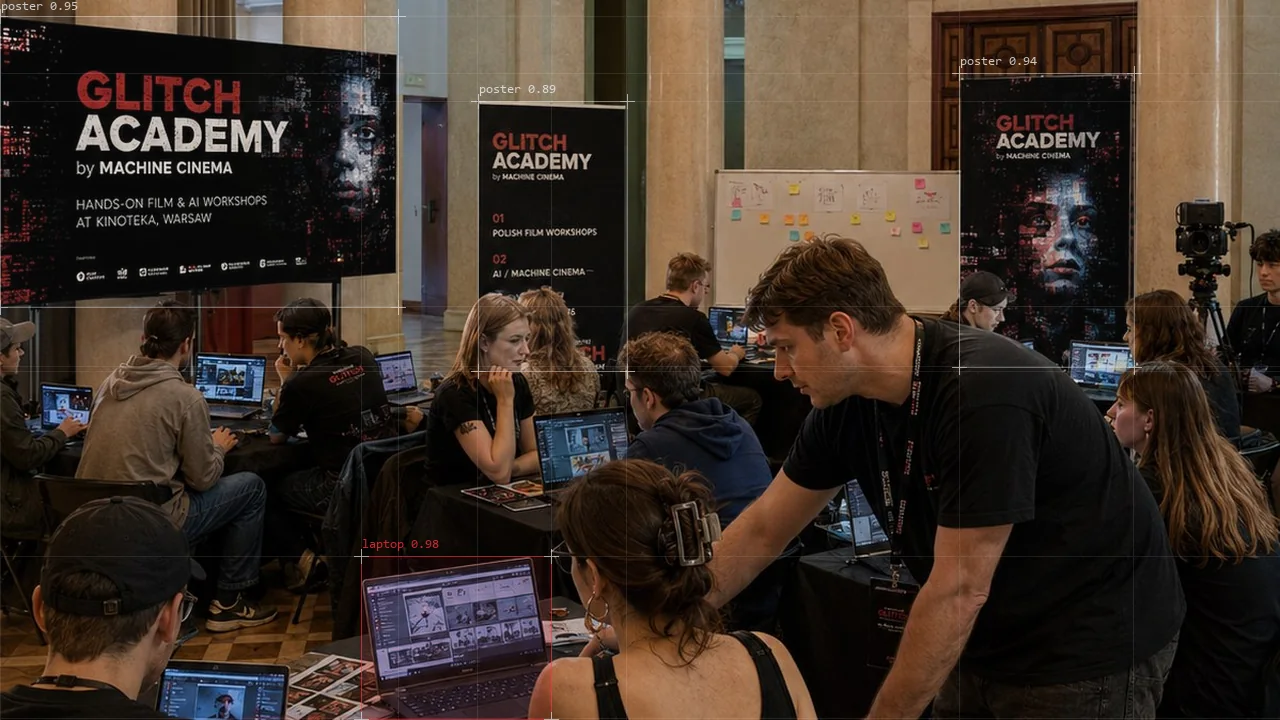
The trophy came home in a very literal sense. The Director’s Cup closing ceremony was held at Warsaw Glitch 2026 in Kinoteka, in the Palace of Culture and Science, with Machine Cinema’s Minh Do, Meg Button and Affan Imran in Warsaw for the occasion.
Original sources: aboutmarketing.pl and Interia (in Polish), Machine Cinema, Director’s Cup hub.
Source: AboutMarketing (opens in a new tab). Facts checked against the source on .